
Business Software
Spreadsheets to dashboard: when your business needs custom software
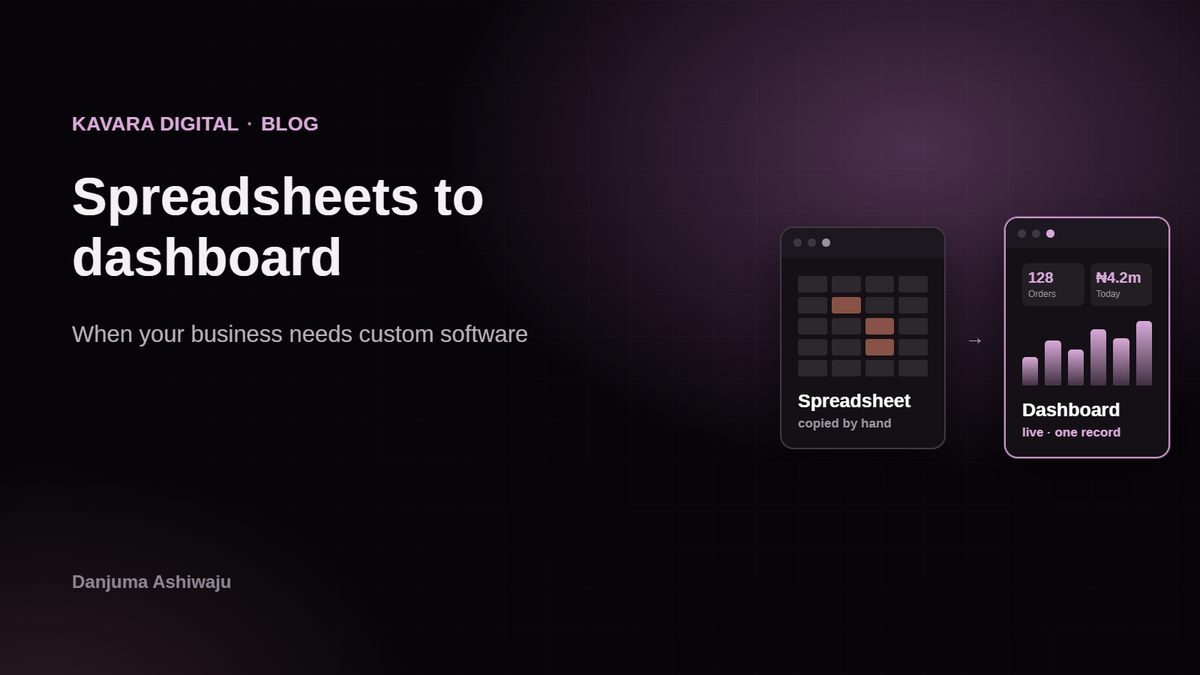
Most growing Nigerian businesses run on the same stack: an Excel sheet, a few WhatsApp groups, a notebook, and one person who knows where everything is. It works surprisingly well, until it doesn't.
I build custom dashboards and business software for companies that have reached that point. This guide covers the warning signs that you've outgrown spreadsheets, when off-the-shelf software is the better choice, and what a custom build actually involves.
Signs you've outgrown spreadsheets
If several of these sound familiar, the spreadsheet is costing you more than you think:
- Orders get lost in WhatsApp. A customer's order is buried under 200 messages in a group chat, and nobody is sure whether it was delivered.
- The same information is typed in three places. Sales go into WhatsApp, then a notebook, then Excel, with mistakes at every step.
- One person holds the master sheet. When they're sick or on leave, nobody else can answer basic questions.
- Month-end takes days. You only find out how the month went after someone spends a week reconciling it.
- You can't see stock or cash in real time. By the time you notice something is missing, it's too late to find out why.
- Approvals happen by voice note. There's no record of who approved what, or when.
- Customers ask for updates you can't give. "Where is my application?" means calling three people to find out.
First, check if off-the-shelf software will do
Custom software isn't always the answer, and I'll say so on a call. If an existing tool fits about 80% of what you do, use it. Accounting, payroll, basic CRM and online stores are well served by products you can subscribe to today, often for less than a custom build would cost.
Custom software makes sense when:
- Your process is how you beat competitors, and generic tools would force you to work like everyone else.
- You're paying for several tools and still copying data between them by hand.
- You have regulated steps, like identity checks, credit decisions or audit trails, that generic tools don't handle well.
- Customers, agents or partners need their own login to see their status, documents or payments.
A worked example: DriveMe Mobility
DriveMe Mobility runs rent-to-own electric vehicle financing for ride-hailing drivers in Nigeria, and also places vetted drivers with companies. A financing business like that has a lot of moving parts: applications, identity checks, credit scores, approvals, money going out to drivers and repayments coming back in. Spreadsheets and separate tools would mean constant copying and no single source of truth.
I built two connected apps for them:
- A public website where drivers apply for financing and companies hire vetted drivers.
- An operator hub where the team works through applications, runs identity checks, sees credit scores, records disbursements and tracks repayments, all in one place, with roles controlling who can see and do what.
The point isn't the technology (React, Supabase and Cloudflare, for the curious). It's that every application now has one record, one status and one history that the whole team can see.
How I approach a build
- Map how work really flows. Before any design, I sit with the people doing the work and follow a real order or application from start to finish.
- Build the smallest version that replaces the spreadsheet. Not every feature on day one: just enough that the team can stop using the old sheet.
- Bring your existing data across, so nobody starts from zero.
- Add roles and an audit log from the start. Knowing who changed what, and when, is what spreadsheets can't do.
- Add AI where it earns its place. Once the data lives in one system, AI can flag problems for you. In my own product Trickle AI, for example, it watches every shift for missing stock, under-pricing and cash shortfalls.
You own the code, the data and the accounts. If you ever want another developer to take over, you can.
What it costs
Custom dashboards and business software start from ₦2 million, quoted after a free call once I understand the process. The price depends mostly on how many different types of user there are, how many steps the process has, and what it needs to connect to, such as payments, identity checks or your accounting tool. Ongoing support is agreed in the quote, so the system keeps improving as your business changes.
Before you call anyone, write this down
- The 3 to 5 tasks your team repeats most every day
- Every tool, sheet and WhatsApp group involved in those tasks
- Who needs to see what, and who should approve what
- The one number you wish you could see live every morning
That list alone will make any quote more accurate. If you'd like to talk it through, book a free 10-minute call, or see more of this kind of work under custom dashboards and business software. And if you also need a public website, here's what websites really cost in Nigeria.