Websites
How much does a website cost in Nigeria in 2026? What you're really paying for
Ask five web designers in Lagos for a quote and you'll get five very different numbers. One says ₦150,000. Another says ₦600,000. An agency sends a proposal for ₦2 million. They can all be honest, because they're quoting for different things, and most quotes don't make clear what those things are.
I publish my prices, so I'll use them as a real example. This guide explains why quotes vary so much, what a ₦250,000 site and a ₦1 million site actually include, and the running costs most quotes leave out, so you can compare offers properly.
The short answer
For most Nigerian small businesses in 2026, a professional website costs roughly:
- ₦150,000 to ₦500,000 for a business website of a few pages, built from a good template.
- ₦450,000 to ₦1.5 million for an online store with payments, or a site with bookings or listings.
- ₦2 million and up for custom platforms with logins, dashboards, payments and integrations.
The build price is only part of the cost. What you pay every year after launch matters just as much, and it's where cheap quotes often hide their real price.
Why quotes vary so much
1. What's actually being built
A four-page site from a ready-made template and a custom-designed site with a booking system are both called "a website". The second can take ten times the work. Before comparing prices, compare the list of pages and features each quote includes.
2. What's included around the site
Some quotes include the logo, the writing, product uploads, business email and Google setup. Others assume you'll provide all of that. A ₦150,000 quote that expects you to write every page and supply every photo can end up costing more in time than a ₦300,000 one that doesn't.
3. The platform it's built on
Many Nigerian sites are built on WordPress with premium themes and plugins. That's quick to set up, but plugins need yearly licences and regular updates, and a neglected WordPress site gets slow and easy to hack. I build on a modern stack instead, which loads faster and has far less to maintain. Neither choice is wrong, but it changes what you'll pay later.
4. Who builds it and who supports it
A freelancer with low overheads can charge less than an agency with a team and an office. What matters more is what happens when something breaks six months later. A low price from someone who stops answering calls is the most expensive option of all.
5. What happens after launch
Hosting, the domain, security updates, backups and small changes all cost something. Some designers include them in a yearly fee; others charge for each request. If a quote doesn't mention them, ask.
What ₦250,000 gets you
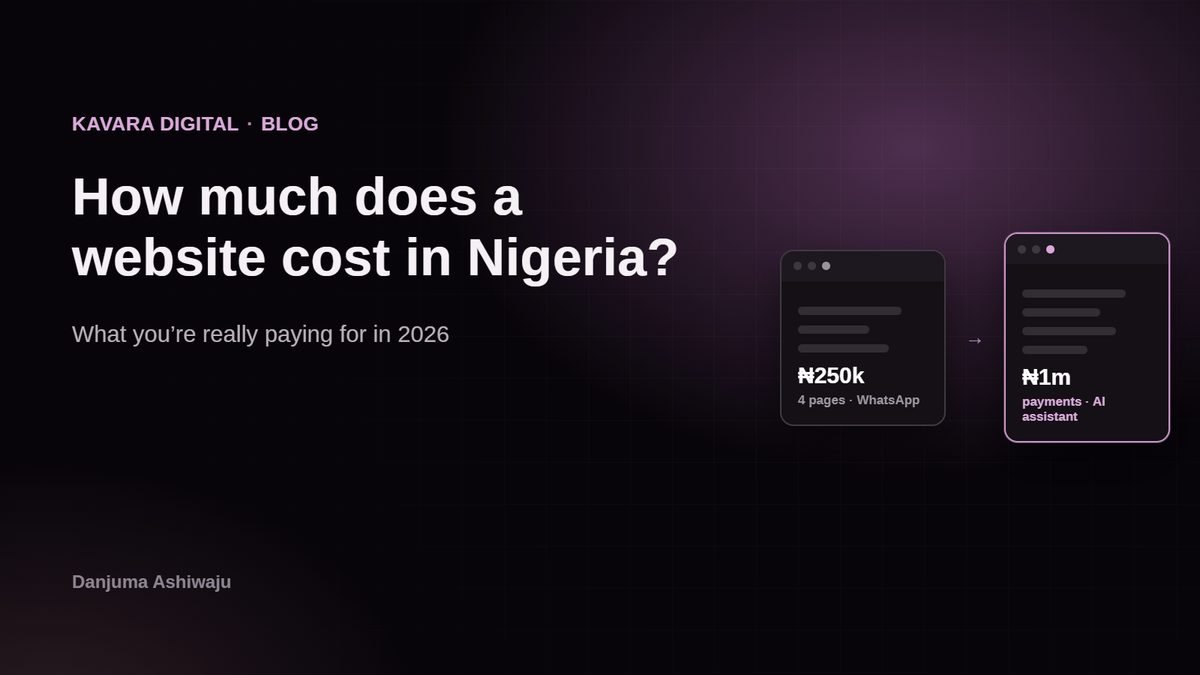
My Starter Website is ₦250,000 at the time of writing (November 2026). For that you get:
- Up to 4 pages, built mobile-first and fast
- A WhatsApp button and a contact form
- Google and AI search setup, so the site can be found and understood
- An AI-assisted logo and 1 business email
It's right for a solo business or side hustle that needs to look credible and get enquiries. It doesn't include online payments, bookings or custom features, and it shouldn't at that price.
What ₦1 million gets you
Around the ₦600,000 to ₦1 million mark, a website starts doing work for you rather than just describing your business. My Online Store (₦600,000) includes a full store with cart, checkout, payment gateways and the first 25 products uploaded. My AI Smart Business package (₦850,000) adds an AI assistant that answers customers on WhatsApp and your website around the clock, trained on your products, prices and FAQs.
At this level you should expect pages you can edit yourself, payments or bookings that work, analytics, and a clear plan for getting found on Google. If a ₦1 million quote is only a nicer-looking brochure site, ask what the extra money buys.
The running costs most quotes leave out
These are the costs that turn up after launch:
- Hosting and domain renewal. Every site needs both, every year. Make sure the domain is registered in your name, not the designer's.
- Plugin and theme licences. Common on WordPress sites, and easy to forget until something stops working.
- Maintenance and security updates. Someone has to keep the site updated and backed up.
- Payment fees. Paystack charges 1.5% + ₦100 on local payments, capped at ₦2,000 per transaction, with the ₦100 waived under ₦2,500.
- WhatsApp message fees. If you use an AI assistant or automated messages on WhatsApp's business platform, Meta charges per message. From 1 October 2026, even replies to customers are charged in Nigeria after a monthly free allowance.
- Changes and new content. Adding pages, products or a new service later.
My website packages include a yearly renewal that covers hosting, updates and support: ₦80,000 for the Starter Website, ₦140,000 for the Business Website and ₦180,000 for the Online Store. I put those numbers on the pricing page because you should know them before you sign, not after.
How to compare two quotes
Ask every designer the same questions:
- Exactly which pages and features are included?
- Who writes the content and provides the photos?
- Will the domain, hosting and code be in my name?
- What does it cost per year after launch, and what does that cover?
- Can I edit the text, prices and photos myself?
- What does "SEO included" actually mean: titles, a sitemap, Google Search Console, speed?
- How fast does the site load on a phone with a weak connection?
Be wary of a quote with no yearly cost at all, a domain registered to the designer, or SEO promised without specifics. They're often how a low price makes its money back.
So what should you spend?
Spend what matches the job the website has to do. If it just needs to make you look credible and get people onto WhatsApp, a ₦250,000 site is plenty. If it needs to take payments, bookings or answer customers while you sleep, budget for the higher tier and judge it by the sales it brings in.
If you're unsure which you need, book a free 10-minute call and I'll tell you honestly, even if the answer is the cheapest option.