
SEO & AI Search
AI SEO: how to get your business recommended by ChatGPT and Google AI
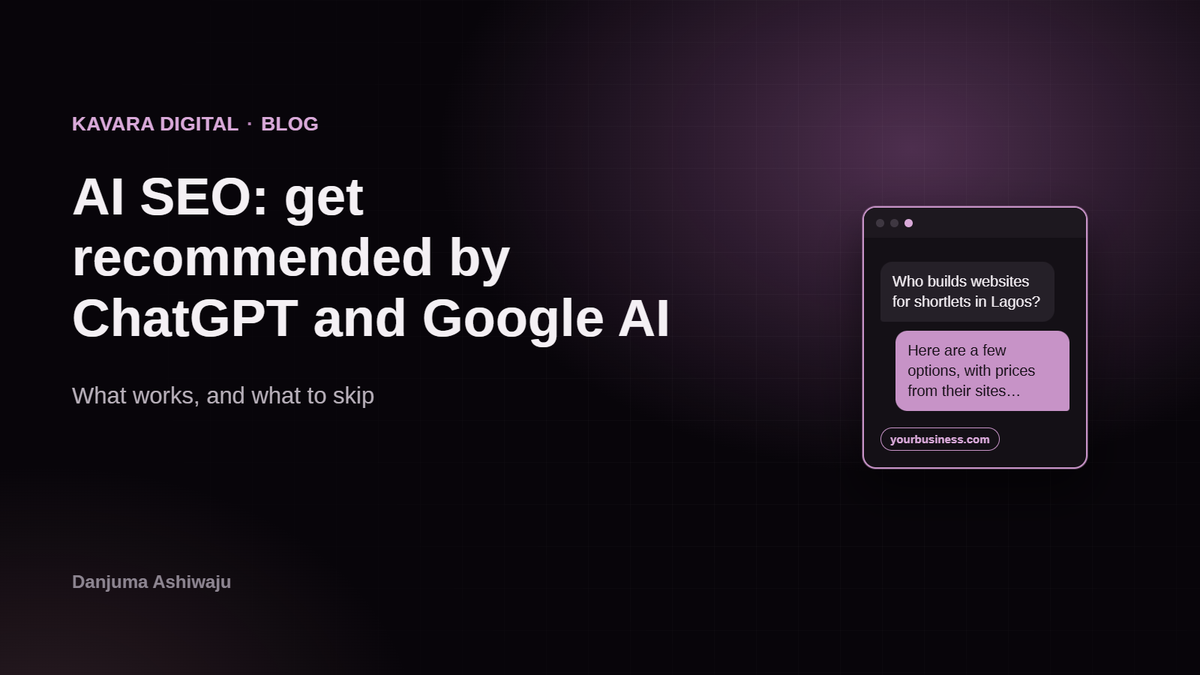
More of your customers now ask an AI before they ask Google's ten blue links. "Who builds good websites in Lagos?" "Best shortlet in Lekki for a family?" They type it into ChatGPT, Perplexity, or Google's AI Mode, which launched in Nigeria in August 2025 and now works in Yoruba and Hausa too.
So how do you get your business into those answers? There's a lot of hype about "AI SEO" and "GEO", and some of it is being sold to business owners who don't need it. This is what actually works, including what Google has said about the tricks that don't.
How AI assistants decide what to recommend
AI assistants that answer questions about businesses mostly search the web, read the pages they find, and summarise the sources they trust. Google's AI Overviews and AI Mode draw on Google's own search index. Other assistants use their own crawlers and search partners.
That means AI SEO is mostly good SEO, plus making your business very easy for a machine to understand. Google says this directly: to appear in its AI features, you need the same things that get you into normal search results.
1. Make sure your site can be read
If a crawler can't read your content, nothing else matters. Check that:
- Your important content is in the page's HTML, not only loaded later by JavaScript. I prerender every public page on the sites I build for this reason.
- Your site loads quickly on a phone.
- Your
robots.txtfile isn't blocking the crawlers you want. Decide deliberately which AI crawlers to allow; some are used for search answers, others for training models. - You're set up in Google Search Console and Bing Webmaster Tools, so you can see what's indexed.
2. Say clearly what you do, where, and for whom
AI assistants quote clear, specific facts. Vague slogans don't get quoted. Compare "innovative digital solutions" with "I build websites and WhatsApp AI assistants for small businesses in Lagos, from ₦250,000". The second gives an assistant something to repeat.
Put your services, the areas you serve, who you serve, your prices or price ranges, your address and how to contact you in plain words on your site. Publishing prices helps here too: when someone asks what something costs, the businesses that state a price are the ones that can be quoted.
3. Answer the questions your customers actually ask
Write down the questions customers ask you on WhatsApp and answer each one properly on your site, in an FAQ or a blog post like this one. A page that answers "how much does a website cost in Nigeria" honestly has a far better chance of being cited than a homepage that never mentions money. That's why I wrote this guide to website costs.
4. Keep your details the same everywhere
Your business name, address, phone number and hours should match on your website, your Google Business Profile, directories, and social profiles. When sources disagree, an AI can't be sure which is right, and it may leave you out or repeat the wrong details.
5. Add structured data
Structured data (Schema.org markup) tells search engines in a standard format what your business is, the services you offer, your prices, your FAQs and who wrote each article. Every site I build generates it automatically on each update, so it never goes out of date.
Be realistic about it, though. Google recommends structured data for rich results in search, but says it isn't a special lever for AI visibility. It helps machines understand you. It won't make up for thin content.
6. llms.txt: useful, but don't pay extra for it
llms.txt is a proposed file that gives AI tools a plain-text summary of your site. My own site has one, regenerated on every build, and I add it to client sites because it costs nothing to maintain.
Here's the honest part. In June 2026 Google updated its documentation to say Google Search, including AI Overviews and AI Mode, doesn't use llms.txt, and that having one won't help or harm you there. Some other AI tools and agents may read it. So treat it as a cheap extra, not a strategy, and don't pay anyone just to create one.
7. Earn real mentions
AI assistants trust businesses that others talk about: genuine reviews on Google, coverage in local press, listings in reputable directories, and partners who link to you. Don't fake any of it. Google's spam policies now explicitly apply to its AI features, and fake mentions or bought links can get you removed rather than recommended.
8. Check whether it's working
- Once a month, ask ChatGPT, Perplexity and Google's AI Mode the questions your customers would ask, and note whether you appear.
- In your analytics, look for visitors arriving from AI tools such as chatgpt.com and perplexity.ai.
- In Google Search Console, track which questions you're showing up for.
What I do for clients
My SEO + AI Search plan covers keyword research, on-page fixes, structured data, Search Console and Bing setup, four blog posts a month and a monthly report, with the aim of getting you found in Google and recommended by AI assistants. It's ₦250,000 a month at the time of writing. You can read more under SEO, AI search, ads and brand.
If you'd like to know where your business stands today, book a free 10-minute call and I'll check how AI assistants currently describe you.